Design the Future of Urban Climate Action
Join Viable Cities, UN-Habitat, and Dark Matter Labs in co-designing a new grant call for system demonstrators that accelerate climate-neutral, resilient cities
System Demonstrators for Climate Action
Testing whole-systems approaches to accelerate urban transitions
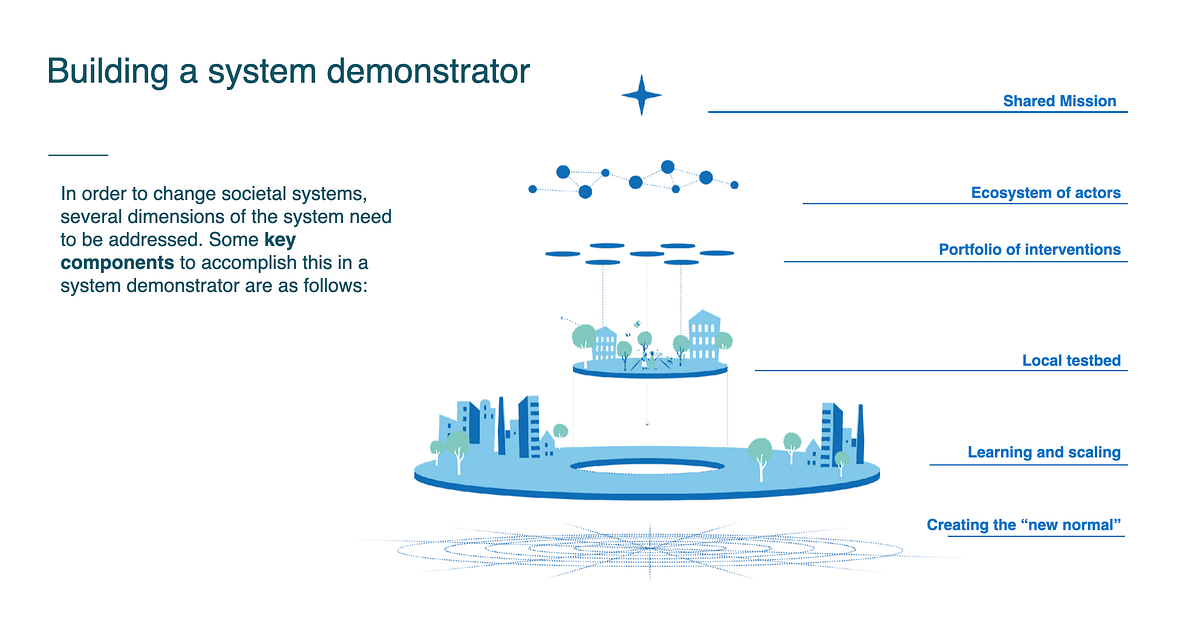
Accelerating and Scaling the Transition
Key components of the system demonstrator methodology
Governance Innovation
Multi-actor climate city contracts and integrated action plans that enable collaborative decision-making across sectors and stakeholders.
Finance Transformation
Blending public, private, and philanthropic investment to create dynamic ecosystems that accelerate sustainable development.
Infrastructure Systems
Integrated energy, mobility, and housing solutions that create the conditions for a new climate neutral normal.
Data-Driven Insights
Smart systems and digital tools that optimize resource use and enable evidence-based decision-making.
Citizen Engagement
Community-led co-design processes that ensure solutions meet local needs and priorities.
Scalable Solutions
Creating replicable frameworks that can be adapted and applied across different urban contexts globally.
Cities Leading the Transition
Real-world examples of system demonstrators in action
EnergyNet: Decentralized Power Revolution
A breakthrough in integrating multiple energy solutions into a unified city-wide system. EnergyNet manages electricity distribution like the Internet - decentralized and software-controlled.
EnergyNet is a new way to manage the distribution of electricity, addressing major challenges in managing local production, storage and sharing. The system is suitable for use in energy communities, but can also be used outside. EnergyNet makes it possible to connect an unlimited amount of local energy resources, which creates completely new conditions for low electricity prices for large quantities of green electricity.
How does it work? EnergyNet is developed according to the same principles as the Internet. It is therefore decentralized, which makes it significantly more resistant to disruptions. Through new types of power electronics, electricity distribution can now be completely controlled by software. Classic challenges for the electricity grid such as frequency and balance are no longer blocking. The new networks are not only decentralized but also distributed, which makes it easier to solve electricity needs as close to the consumer as possible.
The EnergyNet in Lund, driven by the CoAction initiative, was set up as a collaborative multi-stakeholder platform bringing together public authorities, businesses, and citizens to co-design a sustainable energy network. The approach integrates local renewable energy sources, smart grids, and demand-side management to optimize energy use across districts. This collaborative governance model fosters cross-sector partnerships and supports a data-driven approach to managing energy efficiency, helping Lund meet its climate targets while offering a model for scalable urban energy transitions globally.
Affordable Housing Initiative
Addressing the housing crisis through aggregation of small brownfield sites to build net-zero social homes using innovative construction methods and collaborative financing.
Bristol's Affordable Housing Initiative, driven by the Housing Festival, represents a game-changing approach to addressing the city's housing crisis, combining climate-smart and social rent housing solutions. In response to a chronic social housing deficit, with 18,000 people on the waiting list and over 1,000 families in temporary accommodation, the initiative focused on aggregating small brownfield sites across the city to enhance housing viability using Modern Methods of Construction (MMC).
The housing system demonstrator aims to test this aggregation model by building 25 zero-carbon social rent homes across six small sites in Bristol, which would not have been feasible individually. A digital tool was developed to help identify these sites and assess their viability, while a collaborative multi-stakeholder approach—involving Bristol City Council, Atkins Realis, Edaroth, and Lloyds Banking Group—was key to moving from concept to implementation. The project's unique approach also includes a redefined notion of 'viability', integrating social infrastructure investments alongside traditional capital repayment models.
The initiative's innovative approach has garnered support for scaling through the Small Sites Aggregator program, which aims to unlock thousands of small, underutilized brownfield sites across the UK. This strategy is seen as a path towards building 10,000 homes annually and addressing wider housing shortages, with ongoing testing in cities such as Bristol, Sheffield, and London's Lewisham Borough.
Through this work, the Housing Festival has created the Social Housing at Pace Playbook, which outlines a replicable ecosystem solution to deliver affordable, climate-smart housing at scale. By blending public, private, and philanthropic investment, the initiative created a dynamic ecosystem that accelerates the delivery of affordable housing, prioritizing local engagement and long-term sustainability. This approach is revolutionizing how cities can rethink housing challenges by embedding innovation into the policy framework.
Co-Design Process
Join us in developing the global grant call framework
First Co-Design Meeting
Initial gathering to establish framework and objectives
Second Co-Design Meeting
Develop call text and operating structure
Final Co-Design Meeting
Finalize framework and fundraising approach
Delivery of Draft Call
Partners deliberate and align on the call launch via a number of international calls
Shape the Future of Urban Climate Action
Join governments, development donors, philanthropies, foundations, and investors in co-designing a new standard for system demonstrator funding